YonedaAI Research Collective — April 2026

The Homotopical Semantics Trilogy

A complete mathematical framework for understanding, detecting, and preventing LLM hallucination through algebraic topology, dependent type theory, and homotopy type theory.

“Hallucination is not a bug — it’s a theorem.”

3
Research Papers
75
Total Pages
26
Key Theorems
Topos Structure

Research Papers

Three papers forming a logically tight trilogy — Part I diagnoses, Part II prescribes, Part III unifies.
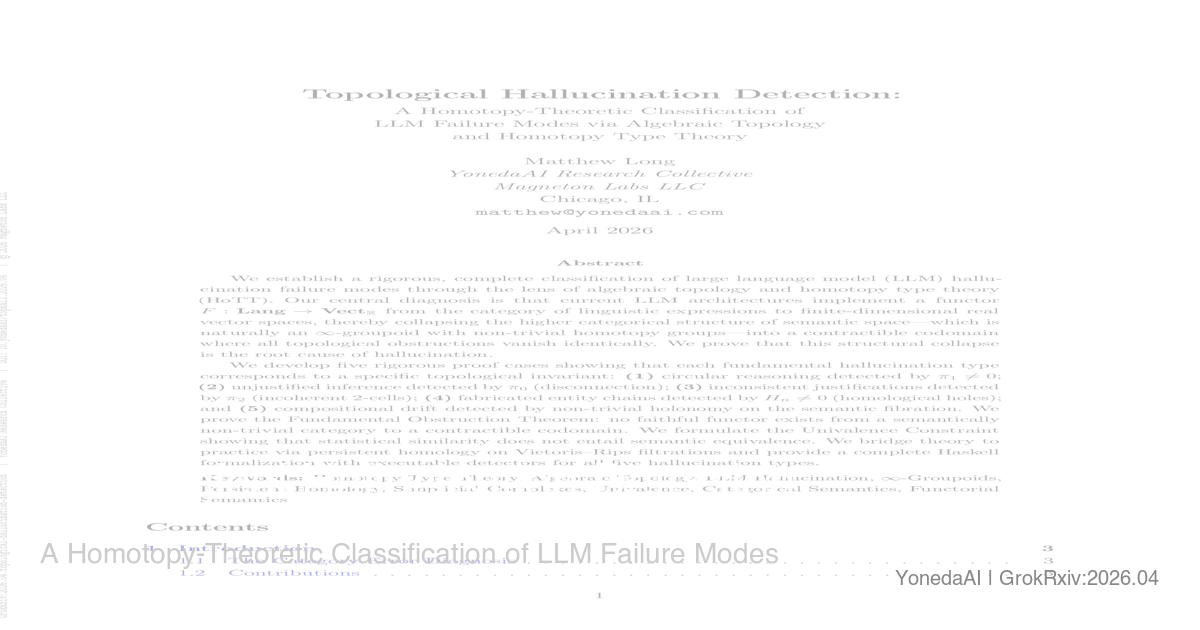
Cover for Topological Hallucination Detection: A Homotopy-Theoretic Classification of LLM Failure Modes
Part I
cs.AI / math.AT23 pages

Topological Hallucination Detection: A Homotopy-Theoretic Classification of LLM Failure Modes

We establish a rigorous, complete classification of large language model (LLM) hallucination failure modes through the lens of algebraic topology and homotopy type theory (HoTT). Our central diagnosis...

Key result5 hallucination types ↔ homotopy invariants (π₀, π₁, π₂, Hₙ, holonomy)
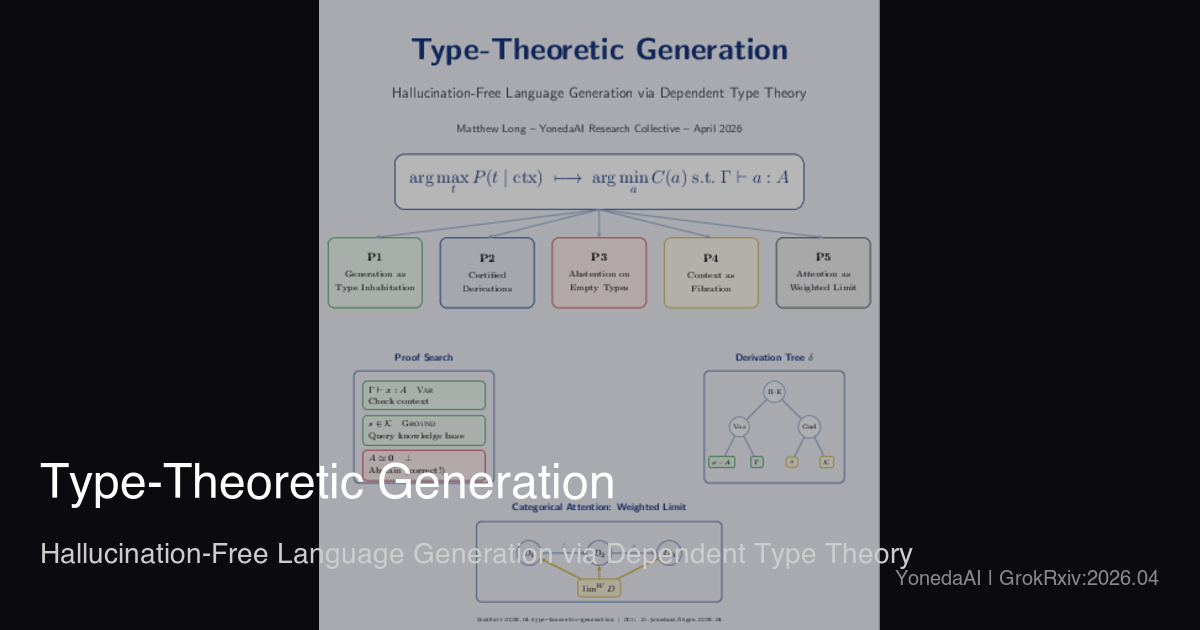
Cover for Type-Theoretic Generation: Hallucination-Free Language Generation via Dependent Type Theory
Part II
cs.AI / math.LO24 pages

Type-Theoretic Generation: Hallucination-Free Language Generation via Dependent Type Theory

We develop a foundational framework for hallucination-free language generation grounded in dependent type theory and categorical semantics. Our central thesis is that language generation should be rec...

Key result5 generation principles replacing sampling with proof search
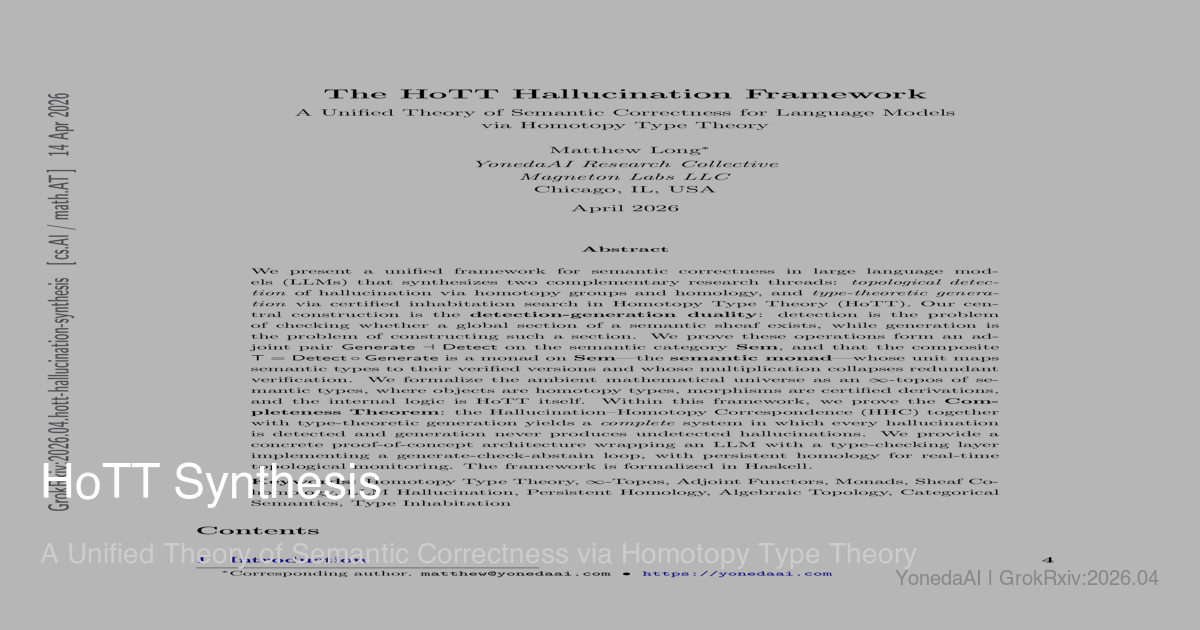
Cover for The HoTT Hallucination Framework: A Unified Theory of Semantic Correctness via Homotopy Type Theory
Part III
cs.AI / math.AT28 pages

The HoTT Hallucination Framework: A Unified Theory of Semantic Correctness via Homotopy Type Theory

We present a unified framework for semantic correctness in large language models (LLMs) that synthesizes two complementary research threads: topological detection of hallucination via homotopy groups ...

Key resultDetection-generation adjunction, semantic monad T = Detect ∘ Generate, Completeness Theorem

The Logical Architecture

Each paper builds on the previous, revealing an emergent structure only visible when all three are read together.

Part IDiagnosis

Topological Detection

Hallucination is structurally inevitable in any system mapping semantic space to a contractible codomain. Five failure modes ↔ five topological invariants.

Part IIPrescription

Type-Theoretic Generation

Replace statistical sampling with type inhabitation. Five generation principles jointly guarantee hallucination-free output via proof search.

Part IIIUnification

HoTT Synthesis

Detection and generation form an adjoint pair. The semantic monad T = Detect∘Generate proves the Completeness Theorem — every hallucination is caught.

Author
Matthew Long
YonedaAI Research Collective · Magneton Labs LLC, Chicago IL
About the Research